
Mango Creek Lodge is proud to announce several new opportunities for our guests and partners to learn more about the lodge.
Our new Web site, www.mangocreeklodge.com, is now live. This iteration has been redesigned and reorganized to better meet our guests’ needs. It also includes two new features to help you stay abreast of our latest news. This blog, Mango Creek Lodge Lodge News, contains information about the daily happenings around our grounds. A companion blog, Mango Creek Lodge Fishing Reports, provides the latest information about fishing conditions and catches. We invite you to check out the new site and blog and tell us what you think.
Also this week, Mango Creek Lodge will be participating in the 2009 International Sportsmen’s Exposition in Denver, Colorado. We hope to reach out to new guests and partners at this one-of-a-kind event. If you’re attending the exposition, please drop by our booth to say hello to owners Terry and Patrice.
Tuesday, January 20, 2009

Sunday, November 30, 2008
A Roatan Thanksgiving
We were delighted to have the opportunity to spend Thanksgiving with a great group of guests this year. Country Pleasures, an active fly-fishing shop in Alberta, Canada, sent a group of nine for the week, and we enjoyed their company immensely.
While the guys hit the flats, Carol Byler, the lone eco adventurer, took advantage of our snorkeling and kayaking sites to explore Port Royal and the Pigeon Cays by water. Carol was a great sport and was introduced to multitudes of new species on her several underwater excursions. Read more about the guys’ adventures on the Mango Creek Lodge fishing blog.
On Thanksgiving, we celebrated our many blessings with a traditional turkey dinner with all the trimmings. The lodge managers took the reins in the kitchen to create an American-style feast of Thanksgiving turkey, mashed potatoes, green bean casserole, cranberry sauce, and rolls. The Mango Creek Lodge cooks contributed with wonderful pumpkin and key lime pies for dessert. It was a great meal and a great way to finish this special day.
 Country Pleasures guests (back, from left) David Byler, Les Guzowski, Larry Briggs, Vincent Ircandia, Don Seaman, Darren Soice, and Mango Creek Lodge Manager Kevin Claughton; (front) Bob Shaunessy, Scott Lenover, and Mango Creek Lodge owners Patrice Heller and Terry Kyle
While the guys hit the flats, Carol Byler, the lone eco adventurer, took advantage of our snorkeling and kayaking sites to explore Port Royal and the Pigeon Cays by water. Carol was a great sport and was introduced to multitudes of new species on her several underwater excursions. Read more about the guys’ adventures on the Mango Creek Lodge fishing blog.
On Thanksgiving, we celebrated our many blessings with a traditional turkey dinner with all the trimmings. The lodge managers took the reins in the kitchen to create an American-style feast of Thanksgiving turkey, mashed potatoes, green bean casserole, cranberry sauce, and rolls. The Mango Creek Lodge cooks contributed with wonderful pumpkin and key lime pies for dessert. It was a great meal and a great way to finish this special day.
 Country Pleasures guests (back, from left) David Byler, Les Guzowski, Larry Briggs, Vincent Ircandia, Don Seaman, Darren Soice, and Mango Creek Lodge Manager Kevin Claughton; (front) Bob Shaunessy, Scott Lenover, and Mango Creek Lodge owners Patrice Heller and Terry Kyle
Tuesday, September 30, 2008
High Tides and Early Rains
If there’s only one thing you’ll remember about Mango Creek Lodge in September, it will be the tides. September always brings unusually high tides to Roatan, but this year might have been a record-breaker. The water continually lapped just below the tops of our docks, and the swift tides washed all sorts of debris in from the ocean.
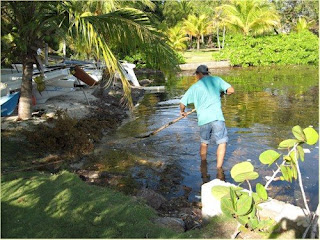 Manuel rakes seaweed from
the Mango Creek Lodge beach
Every few days, the grounds staff had to report to our beach for clean-up duty. They found basketballs, bottles, all varieties of plastic tidbits, tons of seaweed, and—of course—numerous shoes and sandals. It was hard (and sometimes stinky) work, so the fishing guides were happy to get a break from the hauling to take Chuck and Rod Hornor fishing. Read more about their time on the flats in our September fishing report.
Once the raking was complete and the tides finally started to recede, we turned to the decks. Mango Creek Lodge has an extensive system of docks, decks, and stairways, and it all must be treated with sealer yearly to prevent rot. This is another big job, as it is all done by hand and paintbrush. By the end of the month, it was almost all done when the rains started.
October is usually the beginning of rainy season on Roatan. However, it appears it is sneaking up early on us this year. Toward the end of the month, we had a few small showers that built in duration. It’s just a sneak peek of what’s ahead.
In September, we also made progress on some new plans for the lodge. First, we welcomed the return of Dalia, who spent the month on the mainland taking massage classes.
 Dalia, a Mango Creek Lodge
cook and massage therapist
Dalia worked hard to receive her certification and is looking forward to the busy season when she can put her new skills to work and treat our guests’ tired muscles.
Other upcoming developments include the construction of new lodging options. Our treehouse rooms will be built on 16-foot platforms that overlook the grounds and the sea. Their connecting walkways will make them a great option for families and groups. Groups will also look forward to the completion of our double cabana. These rooms will be similar to our existing over-the-water cabanas, but they will share a platform and space. Stay tuned for more information!

 The beginning stages of Mango Creek Lodge's
 Manuel rakes seaweed from
the Mango Creek Lodge beach
Once the raking was complete and the tides finally started to recede, we turned to the decks. Mango Creek Lodge has an extensive system of docks, decks, and stairways, and it all must be treated with sealer yearly to prevent rot. This is another big job, as it is all done by hand and paintbrush. By the end of the month, it was almost all done when the rains started.
October is usually the beginning of rainy season on Roatan. However, it appears it is sneaking up early on us this year. Toward the end of the month, we had a few small showers that built in duration. It’s just a sneak peek of what’s ahead.
In September, we also made progress on some new plans for the lodge. First, we welcomed the return of Dalia, who spent the month on the mainland taking massage classes.
 Dalia, a Mango Creek Lodge
cook and massage therapist
Other upcoming developments include the construction of new lodging options. Our treehouse rooms will be built on 16-foot platforms that overlook the grounds and the sea. Their connecting walkways will make them a great option for families and groups. Groups will also look forward to the completion of our double cabana. These rooms will be similar to our existing over-the-water cabanas, but they will share a platform and space. Stay tuned for more information!

 The beginning stages of Mango Creek Lodge's
 new accommodation options
Sunday, August 31, 2008
Winding Down
With the coming of August, things slowed down at Mango Creek. Of course, no one told the fish that. Early in the month, we found two large permit tailing in the water right in front of the restaurant! They must have been checking in to see what happened to all the fishermen.
 Permit visiting our front-porch waters
With time to focus on the Mango Creek Lodge grounds, our staff got to work. Their first task was to raise the primary pathway to the main lodge. This stretch of walk had washed out a bit from past rains and was taking on water and sand during showers. To fix it, the guys hauled in sand and raised the area under the stepping stones. Then they replaced the stones and dug a drainage canal to better channel future water flow.
 The grounds staff puts the finishing
touches on our improved pathway
Their next task was to build a landscaping wall on the hill above the stairway to the lodge. Manuel, our resident concrete expert, oversaw the construction and cement work. When they were finished, we had a beautiful new planting area to display red ginger plants and control water flow down the hillside.
Manuel also oversaw the construction of a new concrete wall in front of our generator shed. We only run the generator about three hours a day to supplement our renewable power, but when it runs, it can be loud! This wall has helped cut down on the noise by reflecting the sound back toward the shed rather than across the grounds.
And in the midst of all the new construction, the staff still managed to make progress on the ongoing task of revarnishing the lodge. Each year, every piece of wood at the lodge is taken down, sanded, revarnished, and replaced to keep our buildings strong and beautiful. It’s a monumental chore, and it takes months to accomplish!
 Permit visiting our front-porch waters
With time to focus on the Mango Creek Lodge grounds, our staff got to work. Their first task was to raise the primary pathway to the main lodge. This stretch of walk had washed out a bit from past rains and was taking on water and sand during showers. To fix it, the guys hauled in sand and raised the area under the stepping stones. Then they replaced the stones and dug a drainage canal to better channel future water flow.
 The grounds staff puts the finishing
touches on our improved pathway
Their next task was to build a landscaping wall on the hill above the stairway to the lodge. Manuel, our resident concrete expert, oversaw the construction and cement work. When they were finished, we had a beautiful new planting area to display red ginger plants and control water flow down the hillside.
Manuel also oversaw the construction of a new concrete wall in front of our generator shed. We only run the generator about three hours a day to supplement our renewable power, but when it runs, it can be loud! This wall has helped cut down on the noise by reflecting the sound back toward the shed rather than across the grounds.
And in the midst of all the new construction, the staff still managed to make progress on the ongoing task of revarnishing the lodge. Each year, every piece of wood at the lodge is taken down, sanded, revarnished, and replaced to keep our buildings strong and beautiful. It’s a monumental chore, and it takes months to accomplish!
Thursday, July 31, 2008
A Busy Summer at Mango Creek Lodge
July was wonderfully busy at Mango Creek Lodge as we celebrated the return of old friends and welcomed the arrival of new ones.
 Cindy Garrison and her camera crew
filming on Mango Creek Lodge's panga
The month finished in a whirlwind with a full house of anglers hooking up on our flats. Cindy Garrison, host of ESPN’s Get Wild with Cindy Garrison, joined us with a camera crew to learn more about Mango Creek’s environmental and conservation initiatives and to try her luck with our bonefish. Look for future reports about Mango Creek’s inclusion in Cindy’s future projects! Gord and Cathy Joyce returned to the lodge for their third visit. William and Will Talley kept everyone smiling with their great humor and incredible photography. And Sue and Bill Martin showed us how fishing should be done. Read more about this group’s luck on the flats in our July fishing report.
July also presented us with a new responsibility: training a baby parrot. Pita is a sweet little bird who is also a bit mischievous. Patrice, a Mango Creek Lodge owner, adopted Pita while she was here earlier in the year and worked hard to tame and train her.
 Pita on her favorite perch in
the Mango Creek Lodge restaurant
Pita is already talking and has developed a fondness for sitting on people’s heads. We work with her daily, and she has become very loving. She likes to sit on her perch in the restaurant and welcome returning fishermen with a friendly “hello.”
 Cindy Garrison and her camera crew
filming on Mango Creek Lodge's panga
The month finished in a whirlwind with a full house of anglers hooking up on our flats. Cindy Garrison, host of ESPN’s Get Wild with Cindy Garrison, joined us with a camera crew to learn more about Mango Creek’s environmental and conservation initiatives and to try her luck with our bonefish. Look for future reports about Mango Creek’s inclusion in Cindy’s future projects! Gord and Cathy Joyce returned to the lodge for their third visit. William and Will Talley kept everyone smiling with their great humor and incredible photography. And Sue and Bill Martin showed us how fishing should be done. Read more about this group’s luck on the flats in our July fishing report.
July also presented us with a new responsibility: training a baby parrot. Pita is a sweet little bird who is also a bit mischievous. Patrice, a Mango Creek Lodge owner, adopted Pita while she was here earlier in the year and worked hard to tame and train her.
 Pita on her favorite perch in
the Mango Creek Lodge restaurant
Pita is already talking and has developed a fondness for sitting on people’s heads. We work with her daily, and she has become very loving. She likes to sit on her perch in the restaurant and welcome returning fishermen with a friendly “hello.”
Wednesday, March 7, 2007
Batteries and Fishin'
Tuesday, Feb. 6 proved to be a momentous day with the arrival of our new batteries for the lodge. Now you say, “What’s the big deal about the batteries?” Well, there were 24 of them, which Terry and Patrice had purchased to replace our aged original “house batteries.” It had been a test of patience to finally get customs to release them to us on the mainland. Dealing with officials in developing countries can be a a real test. They had been in “battery jail” for weeks as we negotiated the final payment of duty for bringing them into the country. Perry Terry, our mayor for the East end of Roatan, finally got them released and shipped over to Port Royal and the lodge.
Each battery can produce 2.2 volts DC and weighs about 600 lbs. Very heavy! With all 24 linked together, we would be able to easily power all of Mango Creek Lodge. The batteries would run through inverters, which would convert the 24 DC volts to 120 volts AC.
They arrived that bright morning in fine fashion. A huge, bright-red shrimp boat, Sea Angel, that had been converted to a freighter, arrived around 9 a.m. just outside the reef. Slowly, she weaved her way around the Cow and Calf islands. Miguel went out in one of our fishing skiffs to guide her in the rest of the way.
 There was some doubt for a while if she would make it. The ship was very heavy and dragged on the bottom the last few hundred feet to our dock. The boat dwarfed our boat house. Finally, it tied up some 6 feet off the dock. That was as close as it could get being securely planted in the mud on the bottom.
A gang plank was fashioned out of about six 2x6 planks, and soon the first battery was pushed off the boat across the planks and onto our dock. We all cringed in fear as we saw that it would be easy for the battery to plunge into the water between the dock and the boat.
By this time, most of our 20 employees had managed to congregate on our dock to help or simply to watch the event. This, combined with the 10 or so sailors on the ship and Perry Terry’s six men, made for quite a gang.
 The first battery finally made it across the planks, and soon there were four more right behind them. Yikes! The dock was starting to sink! "Stop," I yelled, with what I hoped sounded like authority. They stopped. Whew!
I explained the problem and said no more batteries on the dock until the ones on the dock were moved off. With a great deal of effort and eight men, we managed to get one up on the "battery mobile" and finally moved off the dock. But it was a slow process and also a dangerous one. The battery wobbled as it was moved, threatening to fall off the wagon.
 Randy came to the rescue with our dolly. I thought he was nuts. It was too small to move these batteries. He gamely put one on the dolly and quickly and safely moved it off the dock. Problem solved. All the remaining batteries were moved as quickly as they were moved off the ship.
At the end of the day, the ship was gone, and the crowds cleared. Twenty-four batteries sat silently waiting for the rest of their journey to the top of the hill to their new home at the solar panel building.
The batteries rested for a few days in the shade of the palm trees surrounding our restaurant, and the "battery mobile" was altered twice before we were satisfied that it would be able to move the batteries up the hill.
 Just after the arrival of the batteries, Jean Mueller and her mother, Dorothy, arrived for a holiday. By coincidence, we purchased the batteries through Jean's company, and they managed to arrive at Mango Creek just as we prepared to move the batteries up the hill.
John & Joan Fostroot also arrived for their vacation at the same time. We were all having a great time. Jean insisted on helping with the dishes each evening after dinner. Our guests spent lazy days snorkeling and exploring our surrounding bays, mangroves, and islands.
 Mark Hatter and Cliff Parsons also arrived and added to the festive environment. Mark must have had about $20,000 worth of camera equipment and took some of the best photos we've seen of the lodge. He was writing an article on the lodge for Eastern Saltwater Fly Fishing magazine.
Each night, we feasted on lobster, shrimp, and fresh wahoo fish, all delivered fresh to our door by our local fishermen.
Meanwhile, all was not well on the property. High Rocks, our sports fisherman, was not charging her batteries, and we had to troubleshoot the system to find out what was happening. Our luck was holding. Two catamarans anchored in our harbour came to the rescue. Tom, off Paradox, and John, off Deja Vu, arrived with their electric meters and soon arrived at a conclusion. The battery combiner was shot, and the alternator on the starboard engine was "toast." The solution: Get the alternator fixed and bypass the combiner.
Our main generator had been making an ugly noise. Upon closer inspection, I found the bearing we had put in the previous month was loose in the alternator casing and about ready to fly apart. Our backup generator was also not operational. It needed a new injector, and that would be a problem because the Kubota diesel that powered it was no longer made.
The next day, we were off to the "rodeo" for another adventure down island. Not only were we going to replenish our food supplies, but we were also going to try to solve our mechanical problems. On this island, we consider a 33% success rate to be normal. That means for every three things you try to get done, usually only one works out. We brought Tie-Tie with us to translate (Spanish/Creole) for us.
 Halfway down island is a small town, Barrio Los Fuertes, that is predominately Spanish-speaking. The inhabitants are descendants of the original shrimp fleet that is still centered on the island. We stopped in the middle of town. Off to the side was a cluster of cars having various repairs done. Outside the cars were a number of tin-roofed shacks. Each shack was busy fixing some part of one of the cars in the parking lot.
Tie Tie presented all three of our problems to the mechanics. The first guy took the alternator from High Rocks saying he could repair it. But before he could fix it, we would have to buy him some two-part glue across the street. We did that and returned it to the mechanic. The second mechanic took off in a car looking for a used alternator to replace the one for our main generator. The third guy also took off to find another injector for us.
We soon left the parking lot to continue our shopping for food and hardware for the lodge. Upon our return, all three problems had been solved. It was $30 to rebuild the one alternator, $30 for another used injector, and $80 for the used alternator. Yippee! A 100% day at the rodeo.
Meanwhile, back at the ranch, more guests were starting to arrive. Jeff Wiese and Perry Herst Jr. were set up in cabanas 1 and 2. We bid a fond farewell to Jean and Dorothy, and their cabanas were now occupied by our first contingency of Frenchmen from Paris.
 Neil Harrison booked in for a 12-day visit and soon became part of our staff. He refused to move off our Breakfast Flat just outside the lodge. He and Miguel fished it each day, determined to outsmart the plentiful bonefish.
 Neil then took out our new Hobie Kayak, which can be peddled. Because it moves through the water by peddling, his hands were free to fish. He successfully caught a needle fish, a barracuda, and various jacks and snappers.
He also proved fearless by dropping his fly on an alligator. He thought it was a tarpon but Randy quickly let him know that he may not really want to land that one.
 Feb. 12 saw the final movement of the batteries up the hill to the solar panels. It took 2 days and every man on the property. The most of the first day, the guys insisted on using brute strength to move the batteries up the hill. Halfway through the day, they finally saw the light. The use of pulleys and a long rope would make the job a lot easier. Tie-Tie and Kessel took charge of moving the snatch blocks and the rope as the battery mobile zig-zagged through the trees.
John Logan arrived here on Feb. 18. Terry and Patrice had hired him in Durango to give Julie and I some relief. John, 23 years old, had just graduated college and wanted an adventure. What better place than Honduras? Within a day, he was moved into the boathouse, and training started.
 He quickly learned Panga driving, skiff driving, going to the rodeo, generator starting, and tending bar at night. Yippee! And not only that, he is learning how to do some of this Web development stuff. Our latest fishing report was written by John. He is an avid trout fisherman and is looking forward to learning saltwater fly fishing. That's is, if he has enough time to go play.
Throughout the month, Manuelito continued with his concrete/clay tile walkways. When he finished them, he painted our generator house. Next, he pushed on to paint our main lodge.
 That's about it for this month. Here is a photo of Randy shows his skills with a machete by deftly husking the perfect coconut for a coconut cream pie.
Ed Kettyle
Each battery can produce 2.2 volts DC and weighs about 600 lbs. Very heavy! With all 24 linked together, we would be able to easily power all of Mango Creek Lodge. The batteries would run through inverters, which would convert the 24 DC volts to 120 volts AC.
They arrived that bright morning in fine fashion. A huge, bright-red shrimp boat, Sea Angel, that had been converted to a freighter, arrived around 9 a.m. just outside the reef. Slowly, she weaved her way around the Cow and Calf islands. Miguel went out in one of our fishing skiffs to guide her in the rest of the way.
 There was some doubt for a while if she would make it. The ship was very heavy and dragged on the bottom the last few hundred feet to our dock. The boat dwarfed our boat house. Finally, it tied up some 6 feet off the dock. That was as close as it could get being securely planted in the mud on the bottom.
A gang plank was fashioned out of about six 2x6 planks, and soon the first battery was pushed off the boat across the planks and onto our dock. We all cringed in fear as we saw that it would be easy for the battery to plunge into the water between the dock and the boat.
By this time, most of our 20 employees had managed to congregate on our dock to help or simply to watch the event. This, combined with the 10 or so sailors on the ship and Perry Terry’s six men, made for quite a gang.
 The first battery finally made it across the planks, and soon there were four more right behind them. Yikes! The dock was starting to sink! "Stop," I yelled, with what I hoped sounded like authority. They stopped. Whew!
I explained the problem and said no more batteries on the dock until the ones on the dock were moved off. With a great deal of effort and eight men, we managed to get one up on the "battery mobile" and finally moved off the dock. But it was a slow process and also a dangerous one. The battery wobbled as it was moved, threatening to fall off the wagon.
 Randy came to the rescue with our dolly. I thought he was nuts. It was too small to move these batteries. He gamely put one on the dolly and quickly and safely moved it off the dock. Problem solved. All the remaining batteries were moved as quickly as they were moved off the ship.
At the end of the day, the ship was gone, and the crowds cleared. Twenty-four batteries sat silently waiting for the rest of their journey to the top of the hill to their new home at the solar panel building.
The batteries rested for a few days in the shade of the palm trees surrounding our restaurant, and the "battery mobile" was altered twice before we were satisfied that it would be able to move the batteries up the hill.
 Just after the arrival of the batteries, Jean Mueller and her mother, Dorothy, arrived for a holiday. By coincidence, we purchased the batteries through Jean's company, and they managed to arrive at Mango Creek just as we prepared to move the batteries up the hill.
John & Joan Fostroot also arrived for their vacation at the same time. We were all having a great time. Jean insisted on helping with the dishes each evening after dinner. Our guests spent lazy days snorkeling and exploring our surrounding bays, mangroves, and islands.
 Mark Hatter and Cliff Parsons also arrived and added to the festive environment. Mark must have had about $20,000 worth of camera equipment and took some of the best photos we've seen of the lodge. He was writing an article on the lodge for Eastern Saltwater Fly Fishing magazine.
Each night, we feasted on lobster, shrimp, and fresh wahoo fish, all delivered fresh to our door by our local fishermen.
Meanwhile, all was not well on the property. High Rocks, our sports fisherman, was not charging her batteries, and we had to troubleshoot the system to find out what was happening. Our luck was holding. Two catamarans anchored in our harbour came to the rescue. Tom, off Paradox, and John, off Deja Vu, arrived with their electric meters and soon arrived at a conclusion. The battery combiner was shot, and the alternator on the starboard engine was "toast." The solution: Get the alternator fixed and bypass the combiner.
Our main generator had been making an ugly noise. Upon closer inspection, I found the bearing we had put in the previous month was loose in the alternator casing and about ready to fly apart. Our backup generator was also not operational. It needed a new injector, and that would be a problem because the Kubota diesel that powered it was no longer made.
The next day, we were off to the "rodeo" for another adventure down island. Not only were we going to replenish our food supplies, but we were also going to try to solve our mechanical problems. On this island, we consider a 33% success rate to be normal. That means for every three things you try to get done, usually only one works out. We brought Tie-Tie with us to translate (Spanish/Creole) for us.
 Halfway down island is a small town, Barrio Los Fuertes, that is predominately Spanish-speaking. The inhabitants are descendants of the original shrimp fleet that is still centered on the island. We stopped in the middle of town. Off to the side was a cluster of cars having various repairs done. Outside the cars were a number of tin-roofed shacks. Each shack was busy fixing some part of one of the cars in the parking lot.
Tie Tie presented all three of our problems to the mechanics. The first guy took the alternator from High Rocks saying he could repair it. But before he could fix it, we would have to buy him some two-part glue across the street. We did that and returned it to the mechanic. The second mechanic took off in a car looking for a used alternator to replace the one for our main generator. The third guy also took off to find another injector for us.
We soon left the parking lot to continue our shopping for food and hardware for the lodge. Upon our return, all three problems had been solved. It was $30 to rebuild the one alternator, $30 for another used injector, and $80 for the used alternator. Yippee! A 100% day at the rodeo.
Meanwhile, back at the ranch, more guests were starting to arrive. Jeff Wiese and Perry Herst Jr. were set up in cabanas 1 and 2. We bid a fond farewell to Jean and Dorothy, and their cabanas were now occupied by our first contingency of Frenchmen from Paris.
 Neil Harrison booked in for a 12-day visit and soon became part of our staff. He refused to move off our Breakfast Flat just outside the lodge. He and Miguel fished it each day, determined to outsmart the plentiful bonefish.
 Neil then took out our new Hobie Kayak, which can be peddled. Because it moves through the water by peddling, his hands were free to fish. He successfully caught a needle fish, a barracuda, and various jacks and snappers.
He also proved fearless by dropping his fly on an alligator. He thought it was a tarpon but Randy quickly let him know that he may not really want to land that one.
 Feb. 12 saw the final movement of the batteries up the hill to the solar panels. It took 2 days and every man on the property. The most of the first day, the guys insisted on using brute strength to move the batteries up the hill. Halfway through the day, they finally saw the light. The use of pulleys and a long rope would make the job a lot easier. Tie-Tie and Kessel took charge of moving the snatch blocks and the rope as the battery mobile zig-zagged through the trees.
John Logan arrived here on Feb. 18. Terry and Patrice had hired him in Durango to give Julie and I some relief. John, 23 years old, had just graduated college and wanted an adventure. What better place than Honduras? Within a day, he was moved into the boathouse, and training started.
 He quickly learned Panga driving, skiff driving, going to the rodeo, generator starting, and tending bar at night. Yippee! And not only that, he is learning how to do some of this Web development stuff. Our latest fishing report was written by John. He is an avid trout fisherman and is looking forward to learning saltwater fly fishing. That's is, if he has enough time to go play.
Throughout the month, Manuelito continued with his concrete/clay tile walkways. When he finished them, he painted our generator house. Next, he pushed on to paint our main lodge.
 That's about it for this month. Here is a photo of Randy shows his skills with a machete by deftly husking the perfect coconut for a coconut cream pie.
Ed Kettyle
Thursday, February 1, 2007
Start of Busy Season
The morning of Jan. 7 started with a bit of a scare! Chena arrived for work a little flustered. Now, to come to work, she has to leave her home in Calabash Bight and head out through the reefs in her small skiff into the open ocean. She then travels a mile or so in the open ocean until she goes through the reef into the protection of Port Royal. Sometimes, the waves in the open ocean can be very large. Many times, she does this trip alone in the dark with high wind and waves. This is normal for the Roatanians here; their small boats are their cars.
Well, she told me that while she was out in the big waves, her 15-HP Yamaha motor had broken down because of bad wires. She started working on the motor and was drifting back toward the reef when she spotted Kessel coming her way. Kessel, one of our guides, was going to rescue her. She was sure of that. But when she looked back, he was gone! Undaunted, she managed to get her motor going and finally pass through the reef and arrive at Mango Creek for work. But she was worried now about Kessel. "He must be broken down, too," she said.
Well, it was time for rescue boys. Terry Kyle and I hopped in the Panga, our big boat with the 60 HP on it, and headed out into the ocean. We tracked back toward Calabash, and sure enough, we spotted a small boat battling toward us. It was Kessel with his 16-year-old son, Jake, and they were crashing into the waves head-on and launching into the air off each crest. As they passed us, Terry and I slipped down into the hollow of a wave. Kessel and Jake's boat launched off the the crest of the next wave, and we were actually looking up at the bottom of their skiff! The only part of the boat in the water was the prop! Kessel had that question-mark look on his face that said, "What are you gringos doing out here?"
Everyone arrived in great shape, but as Kessel pointed out after all, he had his paddle and was never in any danger ... . These people are tough, and sometimes it's hard to remember that.
Projects, projects, projects! We were into them.
Miguel and Jake were put to work painting our boat house. We had decided that something had to be done to modify it to resemble the rest of the Cabanas and the restaurant. Julie selected color schemes, and Terry came up with an idea to add some thatch to the structure. Painting began Jan. 8.
A new satellite dish was bought to improve our ability to communicate. Unfortunately, it was almost impossible to get someone to install it. Finally, we tracked down Michael Senn from the mainland, and, boom, the job was done.
 Terry worked away at trying to get our wind generators up and running again. He got one fixed, but it was apparent that the other one had to come down for repairs. Tie-Tie and the rest of the fishing guides and Randy are seen here lowering the towers--a tricky operation at best.
Meanwhile, Julie and I had to have fillings fixed. Off we went to French Harbour for our appointments with Dr. Carla. She worked on me for almost 3 hours giving me a new composite filling in my huge cavity. Julie was in the chair for 1 1/2 hours, too. The bill was $45 for me and $35 for Julie. Not exactly back-home prices.
On the way back, we stopped at The Galaxy ferry to pick up the axles that Terry had made up for a wagon we were making. We also picked up a winch to help bring down our wind generator.
We were expecting a shipment of batteries to arrive from China. These batteries would replace the lodge's aging house battery banks. The shipment would be made up of 24 batteries, each weighing 600 lbs. We needed to move each battery up the hill to our solar arrays--hence, the need for the wagon. Not a fun thing ...
Once back at the lodge, of course, it was discovered that the axels for the wagon were the wrong length and would have to be machined further. This is Honduras. What were we thinking? Terry dropped the parts off the next day for fixing and returned the day after for pickup. He also dropped off plans for a plate to be made up to be used for our backup generator.
When we got there the next day, we were informed that the parts had been picked up and paid for (!) by another gringo in Port Royal. But who? We called everyone but to no avail. Two projects were now on hold until the parts turned up.
 Meanwhile, back at the ranch, the thatching of Cabana 3 was in full swing. Leaf had been purchased for the roof and had been drying for about 2 weeks. Randy, Kessel, and Tie-Tie removed all the old thatch. Next, new leaf was carried up by ladder and placed carefully by Randy. Fishing nets were then placed over the full roof to protect the thatch from big winds.
The painting of the boat house continued with Miguel and Jake working away with multi-colored paint.
The front doors to the restaurant were taken away to be sanded and revarnished by Antonio and Rafael. They temporarily nailed up a large piece of cardboard to keep the weather out.
With the Arrival of High Rocks, the new sports fishing boat, came two new projects. The first was a new dock for the new boat. Perry Terry (our mayor and contractor) had a whole gang of his men busy putting in pilings and building our new dock.
 In the meantime, Manuelito, a magician in concrete work, was hired to build a new pathway to the new dock. Sand and gravel were dug out of Mango Creek for the concrete walkways.
Rigo mixed the concrete in a wheelbarrow, and Don Julio broke up clay roofing tiles to make the inserts for the walkway. As the days passed, Mango Creek Lodge increased her gardens and pathways.
 During the month, we were also visited by a number of customers. Phil Clough from Toronto spent a week chasing all our saltwater fish. After catching numerous bonefish, he became totally focused on catching tarpon and permit. He was very successful, and here is Perry with one of his tarpon. After this catch, he decided that landing them in the fishing skiff was not so cool. This fish almost destroyed his rods!
Miguel got his first day fisherman from Reef House. They went out spin fishing and caught a bonefish and a nice 60-lb tarpon. The fisherman, Dave from Philadelphia, was very happy and promised to return with his wife next time.
 The last week of January, the fishing really heated up. All four of our cabanas were booked, with two men per cabana. Four were from West Virginia, and four were from Utah. All eight were fishing. All our fishing guides were busy and so were all the cooks. Each evening at dusk, the tired men would return looking forward to a cold beer and a home-cooked meal.
Our luck was good in the restaurant, too. Every day or so, a local fisherman would come by our lodge selling lobster, shrimp, wahoo, and snapper.
Unfortunately, Terry left us mid month just as things were heating up. He returned for the expected birth of a brand-new grandson.
Having everyone busy fishing was good for business but bad for the projects. The answer was to hire some summer students to help out with the work.
Jake, Kessel's son, helped with yard work, and Rebecca, Ilee's sister, helped with the laundry and cleaning.
Eventually, the missing parts that were given to the wrong people by the machine shop down island were returned to the machine shop. And then they eventually made their way to Mango Creek. We never knew who the strange gringo was. So our workshop got busy right away and made up a go-cart the looked like it was on steroids. Each wheel was a special wheelbarrow wheel on bearings. We all passed inspection and decided it probably could carry a 600-lb battery. After all, it passed the Rigo test, and he bounced as hard as he could on it.
Ed Kettyle
Well, she told me that while she was out in the big waves, her 15-HP Yamaha motor had broken down because of bad wires. She started working on the motor and was drifting back toward the reef when she spotted Kessel coming her way. Kessel, one of our guides, was going to rescue her. She was sure of that. But when she looked back, he was gone! Undaunted, she managed to get her motor going and finally pass through the reef and arrive at Mango Creek for work. But she was worried now about Kessel. "He must be broken down, too," she said.
Well, it was time for rescue boys. Terry Kyle and I hopped in the Panga, our big boat with the 60 HP on it, and headed out into the ocean. We tracked back toward Calabash, and sure enough, we spotted a small boat battling toward us. It was Kessel with his 16-year-old son, Jake, and they were crashing into the waves head-on and launching into the air off each crest. As they passed us, Terry and I slipped down into the hollow of a wave. Kessel and Jake's boat launched off the the crest of the next wave, and we were actually looking up at the bottom of their skiff! The only part of the boat in the water was the prop! Kessel had that question-mark look on his face that said, "What are you gringos doing out here?"
Everyone arrived in great shape, but as Kessel pointed out after all, he had his paddle and was never in any danger ... . These people are tough, and sometimes it's hard to remember that.
Projects, projects, projects! We were into them.
Miguel and Jake were put to work painting our boat house. We had decided that something had to be done to modify it to resemble the rest of the Cabanas and the restaurant. Julie selected color schemes, and Terry came up with an idea to add some thatch to the structure. Painting began Jan. 8.
A new satellite dish was bought to improve our ability to communicate. Unfortunately, it was almost impossible to get someone to install it. Finally, we tracked down Michael Senn from the mainland, and, boom, the job was done.
 Terry worked away at trying to get our wind generators up and running again. He got one fixed, but it was apparent that the other one had to come down for repairs. Tie-Tie and the rest of the fishing guides and Randy are seen here lowering the towers--a tricky operation at best.
Meanwhile, Julie and I had to have fillings fixed. Off we went to French Harbour for our appointments with Dr. Carla. She worked on me for almost 3 hours giving me a new composite filling in my huge cavity. Julie was in the chair for 1 1/2 hours, too. The bill was $45 for me and $35 for Julie. Not exactly back-home prices.
On the way back, we stopped at The Galaxy ferry to pick up the axles that Terry had made up for a wagon we were making. We also picked up a winch to help bring down our wind generator.
We were expecting a shipment of batteries to arrive from China. These batteries would replace the lodge's aging house battery banks. The shipment would be made up of 24 batteries, each weighing 600 lbs. We needed to move each battery up the hill to our solar arrays--hence, the need for the wagon. Not a fun thing ...
Once back at the lodge, of course, it was discovered that the axels for the wagon were the wrong length and would have to be machined further. This is Honduras. What were we thinking? Terry dropped the parts off the next day for fixing and returned the day after for pickup. He also dropped off plans for a plate to be made up to be used for our backup generator.
When we got there the next day, we were informed that the parts had been picked up and paid for (!) by another gringo in Port Royal. But who? We called everyone but to no avail. Two projects were now on hold until the parts turned up.
 Meanwhile, back at the ranch, the thatching of Cabana 3 was in full swing. Leaf had been purchased for the roof and had been drying for about 2 weeks. Randy, Kessel, and Tie-Tie removed all the old thatch. Next, new leaf was carried up by ladder and placed carefully by Randy. Fishing nets were then placed over the full roof to protect the thatch from big winds.
The painting of the boat house continued with Miguel and Jake working away with multi-colored paint.
The front doors to the restaurant were taken away to be sanded and revarnished by Antonio and Rafael. They temporarily nailed up a large piece of cardboard to keep the weather out.
With the Arrival of High Rocks, the new sports fishing boat, came two new projects. The first was a new dock for the new boat. Perry Terry (our mayor and contractor) had a whole gang of his men busy putting in pilings and building our new dock.
 In the meantime, Manuelito, a magician in concrete work, was hired to build a new pathway to the new dock. Sand and gravel were dug out of Mango Creek for the concrete walkways.
Rigo mixed the concrete in a wheelbarrow, and Don Julio broke up clay roofing tiles to make the inserts for the walkway. As the days passed, Mango Creek Lodge increased her gardens and pathways.
 During the month, we were also visited by a number of customers. Phil Clough from Toronto spent a week chasing all our saltwater fish. After catching numerous bonefish, he became totally focused on catching tarpon and permit. He was very successful, and here is Perry with one of his tarpon. After this catch, he decided that landing them in the fishing skiff was not so cool. This fish almost destroyed his rods!
Miguel got his first day fisherman from Reef House. They went out spin fishing and caught a bonefish and a nice 60-lb tarpon. The fisherman, Dave from Philadelphia, was very happy and promised to return with his wife next time.
 The last week of January, the fishing really heated up. All four of our cabanas were booked, with two men per cabana. Four were from West Virginia, and four were from Utah. All eight were fishing. All our fishing guides were busy and so were all the cooks. Each evening at dusk, the tired men would return looking forward to a cold beer and a home-cooked meal.
Our luck was good in the restaurant, too. Every day or so, a local fisherman would come by our lodge selling lobster, shrimp, wahoo, and snapper.
Unfortunately, Terry left us mid month just as things were heating up. He returned for the expected birth of a brand-new grandson.
Having everyone busy fishing was good for business but bad for the projects. The answer was to hire some summer students to help out with the work.
Jake, Kessel's son, helped with yard work, and Rebecca, Ilee's sister, helped with the laundry and cleaning.
Eventually, the missing parts that were given to the wrong people by the machine shop down island were returned to the machine shop. And then they eventually made their way to Mango Creek. We never knew who the strange gringo was. So our workshop got busy right away and made up a go-cart the looked like it was on steroids. Each wheel was a special wheelbarrow wheel on bearings. We all passed inspection and decided it probably could carry a 600-lb battery. After all, it passed the Rigo test, and he bounced as hard as he could on it.
Ed Kettyle
Subscribe to:
Posts (Atom)